

How to Spot a Good Drone Show: Display, Parade or Show?
Three quality levels to know before you bookYou cannot judge a good drone show by the number of drones. Anyone who has watched several drone shows over the past few years knows the moment: the first formations impress, and five minutes later the audience is looking at their phones. That is rarely down to the technology. The drones fly precisely, the images stand cleanly in the sky. It happens because many productions are not a show at all. They are a display.
One motif appears, rotates, dissolves. The next appears. In between, light effects fill the time. The result is a billboard in the sky: every single image is recognizable, but nothing connects them. We call this a drone display, because otherwise the distinction cannot be made in a sales conversation. Once you know it, you can tell from the quotation what you will get on the night. We distinguish three levels: Display, Parade, Show.
Level 1: The Drone Display
A display shows motifs. It lines them up, usually in the order the approvals came in: main sponsor logo, anniversary number, landmark, heart, closing logo. Each motif is briefly animated, then faded out. The transition is a blackout or a color change across the whole swarm.
Music often runs alongside, but it is not locked to the show. It starts when the drones take off and ends when they land. Whether a motif lands on a beat is a matter of chance.
A display is therefore not wrong in itself. For a product reveal at a trade fair, for example, where a single image has to hold perfectly for fifteen seconds, it is exactly right. As the eight minute finale of a town festival it does not carry, because the audience has understood how it works after the third motif and the rest is repetition. So anyone trying to spot a good drone show starts by asking whether the occasion calls for a narrative at all.
How to recognize it in a quotation: the conversation is about numbers. Number of drones, number of motifs, number of minutes.
Level 2: The Parade
At the second level the motifs are sorted by theme and the music is roughly matched. The change between two images falls somewhere near a chorus, and the pace of the animation follows the pace of the track. A rhythm emerges, and the audience stays with it longer.
What is missing is the connection. A parade passes by: every image is finished in itself, none of them needs the one before it, and you could swap the order without losing anything. The transition is a change, not an event. Ask the audience the next day and they remember individual motifs, not a progression.
The larger part of what is sold as a drone show today sits at this level. That is not carelessness, it is a question of production effort: a parade can be assembled from a motif library. A show, by contrast, has to be built for this one evening from the first second. That is why a good drone show can be identified from the quotation, long before the first drone takes off.
How to recognize it in a quotation: there is a running order with a motif list and time markers, but no dramaturgy.
Level 3: The Show
A show tells a story. It has a beginning that sets an expectation, a middle that raises it, and an ending that pays it off. There are pauses, but they are placed rather than left over. A dramaturgical pause holds tension, dead air loses it, and the audience feels the difference immediately even when they cannot name it.
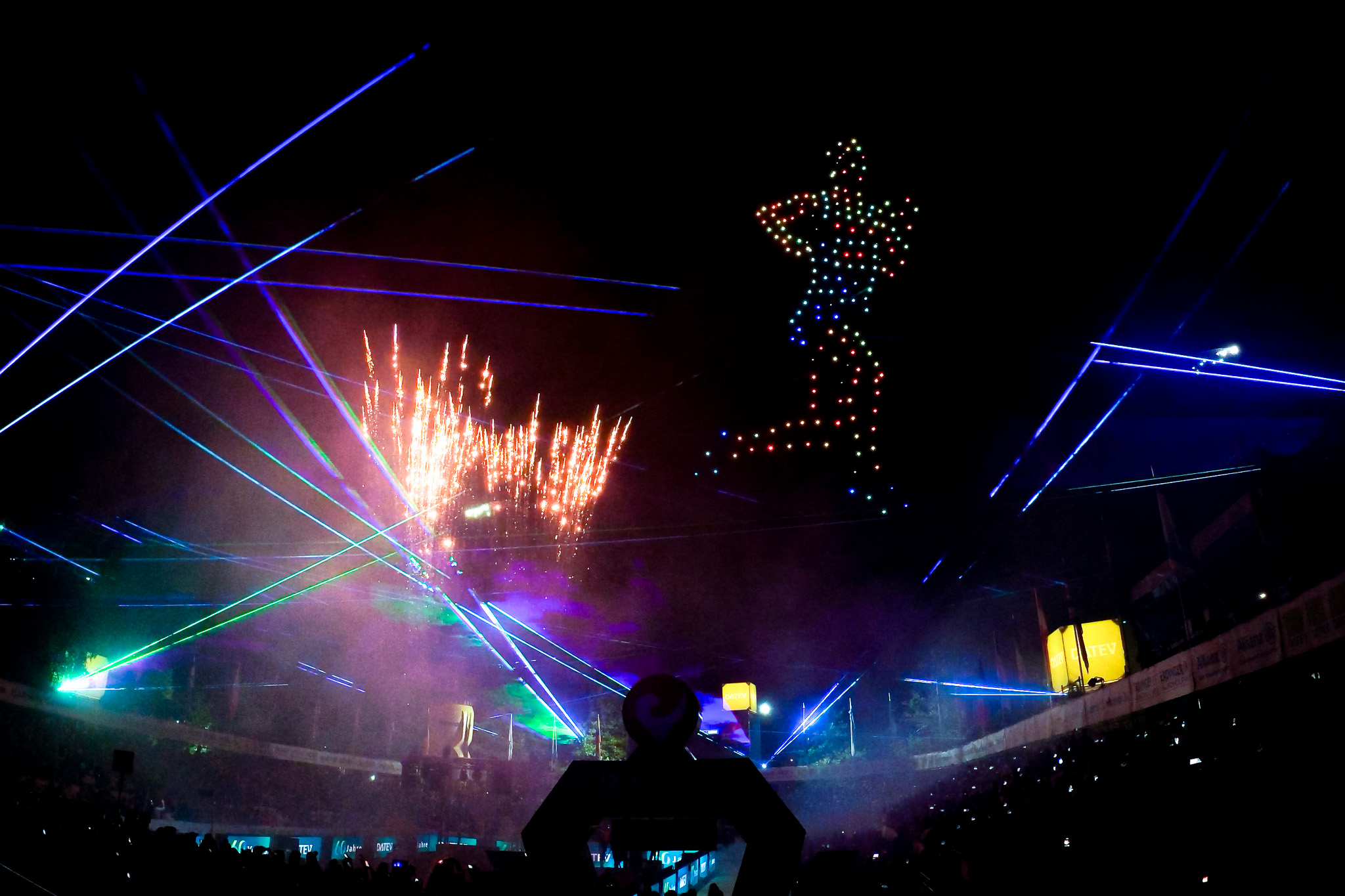
At this level nothing is counted any more. One image becomes the next without the swarm going dark in between. The swimmer becomes the cyclist, the cyclist becomes the runner. At the DATEV Challenge Roth we built exactly that with 180 drones over the finish area: three disciplines as one continuous movement, joined by lasers and pyrotechnics, resolving into the organizer’s logo. Nobody in the stadium saw three motifs. They saw a race.
At this level the music is not a backdrop but a metronome. Show, lighting and sound run on a shared timecode so that an image lands exactly on the accent rather than roughly near it. At Wacken 2024 the production was locked to the stage, the lighting and the special effects.
How to recognize it in a quotation: the conversation is about the progression before it is about the number of drones.
You Spot a Good Drone Show at the Transition
Nowhere do display and show separate as clearly as at the transition. In a display it is the gap between two motifs, the part you have to bridge technically. In a show, by contrast, it is part of the story. So when you have to choose between two quotations, look past the motifs and at what happens between them.
It is also the most demanding part of the production. Building a motif is craft. Moving two motifs into one another so that the movement itself carries meaning is choreography. Transitions therefore show up in the budget, and that is why comparing two offers on price per drone is misleading. What a production actually costs, and what the price is made of, we have broken down in detail.
Other Trades: When the Drone No Longer Stands Alone
It is also the most demanding part of the production. Building a motif is craft. Moving two motifs into one another so that the movement itself carries meaning is choreography. Transitions therefore show up in the budget, and that is why comparing two offers on price per drone is misleading. What a production actually costs, and what the price is made of, we have broken down in detail.
The combination only becomes worthwhile when every trade has a job in the progression: the laser draws the line of sight, pyrotechnics set the accent, stage lighting ties the ground to the sky. At Rietberger Himmelsleuchten 2025 we combined 350 drones carrying adapted fireworks with classic ground pyrotechnics. It was the first officially approved pyro drone show in Germany. With combinations like this, the approval process is a fixed part of the production and has to be planned early, because handling pyrotechnic compositions requires a permit under the German Explosives Act.
The Right Number for the Right Event
None of this means that fewer drones are always the better choice. How many you need depends on two variables, and the content is only the first.
The second is the size of the show, because that follows from the site. What matters is viewing distance, how the audience is spread across the ground, the sightlines and the ambient light. If your audience is spread over several hundred meters of festival ground, you need an image that still has surface area from the back row. A larger image requires either more space between the aircraft, which frays the outline, or more aircraft to keep the line closed.
Two of our productions show the range. At the Berlin Olympic Stadium we worked with 750 drones at roughly 300 meters of formation width, because the stands see the image from a long distance and from very different angles. At the DATEV Challenge Roth it was 180 over the finish area, because the audience there stands close to the field. Both numbers are right for their event, and neither could be transferred to the other.
Too few drones across a large area produce an image that falls apart at a distance. Too many across a small area cost budget that would be better spent on the choreography, without the effect improving. The question is therefore never how many drones a supplier can put in the air, but what show size the site demands and how many aircraft carry that size cleanly.
“I have nothing against a display. There are occasions where it is the right format, and I have built some myself. What is changing is the audience. The medium is young, but the viewers have become demanding: after their third drone show, people compare. Anyone who comes expecting a show and gets a display is rightly disappointed. It was not the technology that let them down, it was the promise.”
— Peter Smiatek, Managing Director, SMIA Technology
Nine Questions That Reveal a Good Drone Show
- Does the quotation describe a dramaturgical progression or a motif list?
- How are the transitions between the motifs described?
- Is the music locked to the show, and by what method?
- Who composes or edits the audio, and when will it be ready?
- Are motifs built from scratch or taken from a library?
- What job do lasers, lighting and pyrotechnics have in the progression?
- How are wind and rain handled, and at what threshold is the show called off?
- What viewing distance and audience distribution is the show size designed for?
- Which reference can the supplier show in which a story is recognizable?
Ask these nine questions and the first answer usually places the supplier for you, without you having to force it.
The Bottom Line
So a good drone show is not something you spot by the number of drones. A display with 500 aircraft is still a display. A show with 180, by contrast, can carry an audience through eight minutes. What matters above all is whether something happens between the images.
The number of drones decides something else, and it matters just as much: whether the image arrives where your audience is standing. Both belong in the conversation, in that order. First the progression, then the site, then the number.
If you want a show for your event and not an advertisement in the sky, talk to us about the progression before we talk about technology.
Nine Questions That Reveal a Good Drone Show